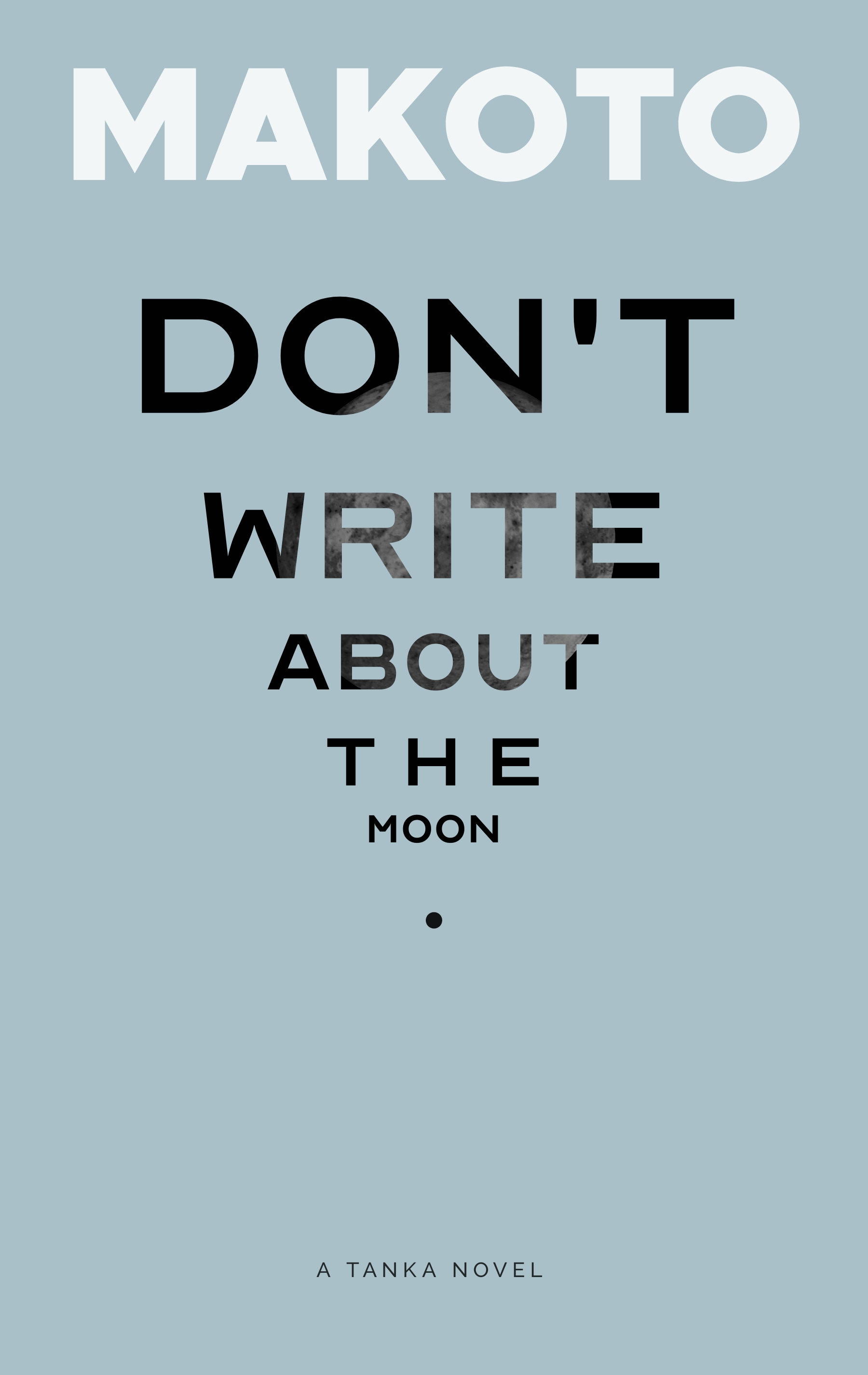
Don’t Write About the Moon
€9.90
‘A moth, a nocturnal creature, finds its way in the dark.’
In her debut tanka novel, Makoto metamorphoses—craving a flight path, fluttering through open windows, turning back at closed doors. She rests for a moment on a comforting hand, only to escape as quickly as she’s caught. And in the darkest corners of this book-length sequence, she asks herself: how much should I succumb to the light?
Details
- Publisher : BoD — Books on Demand (November 13, 2025)
- Language : English
- Paperback : 108 pages
- ISBN-10 : 3695144424
- ISBN-13 : 978-3-695-14442-6
- Dimensions : 12 x 0.8 x 19 cm
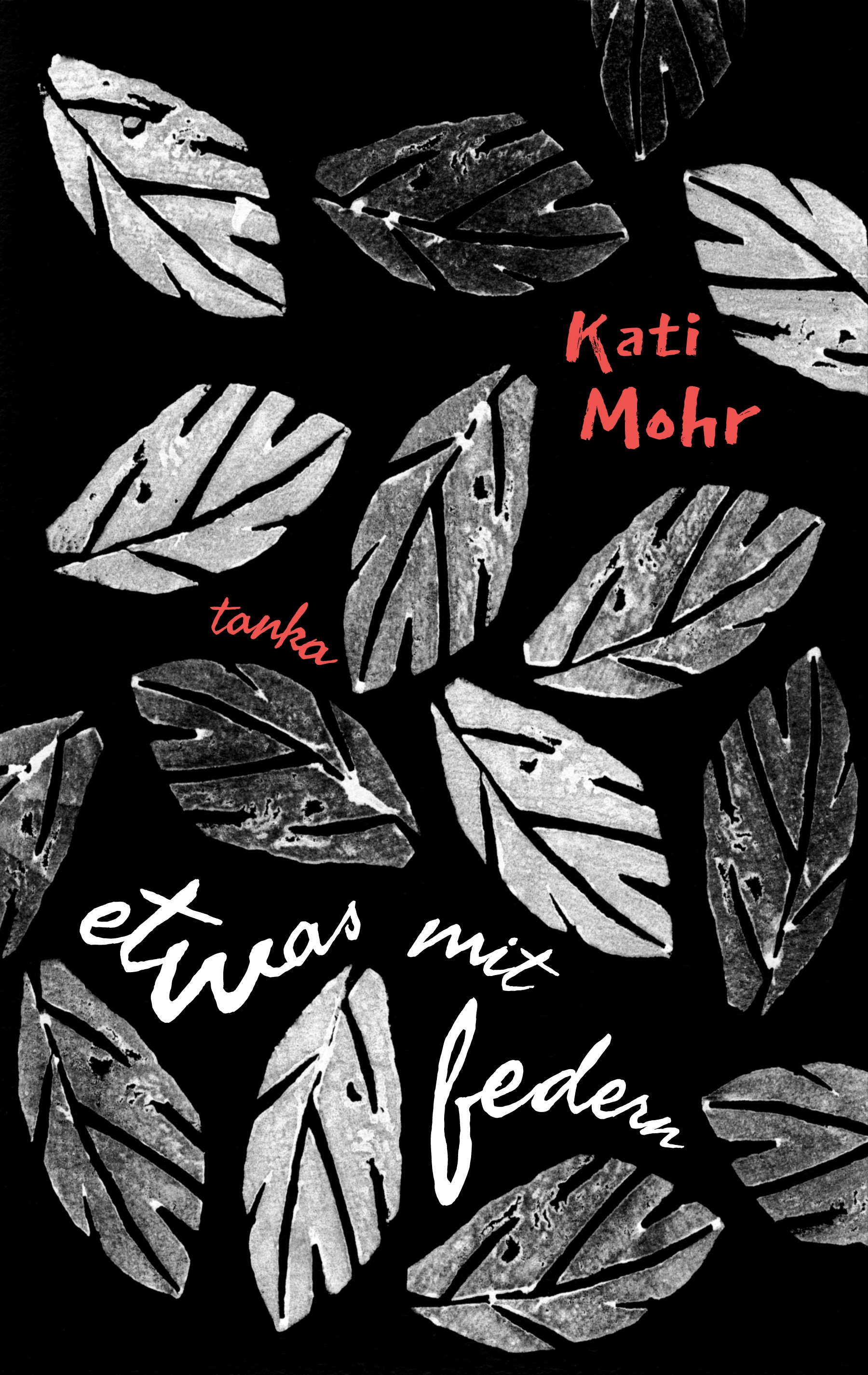
etwas mit federn
€6.49
“Wenn Sie sich nach kühnen, originellen und vielschichtigen Tanka sehnen, sind Sie hier genau richtig.”
Ken Slaughter
Editor, The Tanka Hangout in Ribbons
“Katis Kurzformgedichte sind mir in der Haikai-Gemeinschaft immer als einzigartig aufgefallen. Es ist schwer in Worte zu fassen, was sie so einzigartig macht. Ich denke, ihre Wortwahl ist besonders geschickt in ihrer minimalistischen Qualität und ihre Gegenüberstellungen sind immer überraschend.”
R.C. Thomas
“Und es gibt so viel in diesem Buch über das Menschsein, das Lebendigsein. (…) Ihre Tanka wirken auf mich leicht, kunstvoll, spontan und fast spielerisch, sowohl geschlossen als auch offen, komplex, fesselnd und süchtig machend[.]”
A A Marcoff
Review im Blithe Spirit Journal (British Haiku Society), 34.3
Details
- Publisher : Books on Demand (June 17, 2025)
- Sprache : Deutsch
- Paperback : 68 Seiten
- ISBN-10 : 3819211098
- ISBN-13 : 978-3819211096
- Dimensions : 12 x 0.5 x 19 cm
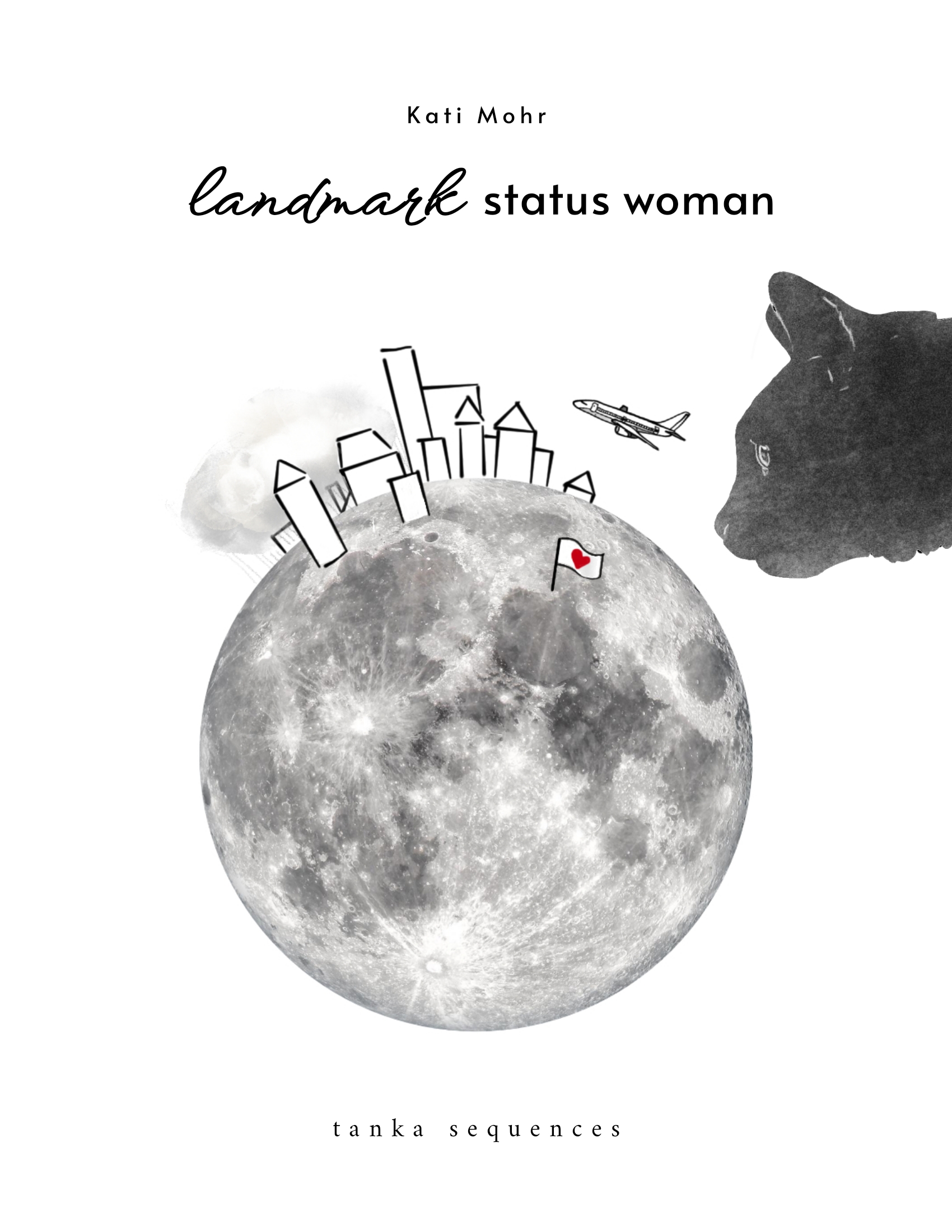
landmark status woman
€9.99
Six tanka sequences that explore spaces of (dis)connectedness: family, partnership, friendship, the self.
“In Japanese micropoetry, the technique of linking to a verse while also shifting away from it is an important technique– Mohr elevates it to an ideology in landmark status woman. The relationship between title and sequences, to the images they are sometimes ensconced in, and of the sequences to each other, create crackling layers of energy. The complex yet genial language invites the reader to return to the book again and again, searching for a meaning that is elusive because it shifts from one reading to another. […]
Mohr’s work is deeply humanistic, implicitly feminine and feminist.”
Pippa Phillips
Review in Pan Haiku Review issue 5
Details
- Publisher : Bod – Books on Demand (October 23, 2024)
- Language : English
- Paperback : 140 pages
- ISBN-10 : 375975208X
- ISBN-13 : 978-3759752086
- Item Weight : 6.2 ounces
- Dimensions : 5.83 x 0.3 x 8.27 inches
Complete review
Pippa Phillips: landmark status woman
Review in Pan Haiku Review issue 5 (Summer 2025)
“Kati Mohr’s landmark status woman is a collection of tanka sequences– including a sequence of cartoon haiga. The poems are arranged in chapter-like collections whose titles invite us to reflect on their themes in indirect ways. The work is lyrical but grounded– resonant emotions are punctuated with plainspoken colloquialisms. Although the poems in the volume stand on their own merits, they grow and reveal more in their relation to each other.
Kati Mohr is a prolific German poet whose intuitive, boundary-pushing work in micropoetry has appeared widely in poetry journals. She has previously published a work of tanka, something with feathers. Her work is subjective and observational, which provides a strong grounding for the author’s tendency to experiment.
In Japanese micropoetry, the technique of linking to a verse while also shifting away from it is an important technique– Mohr elevates it to an ideology in landmark status woman. The relationship between title and sequences, to the images they are sometimes ensconced in, and of the sequences to each other, create crackling layers of energy. The complex yet genial language invites the reader to return to the book again and again, searching for a meaning that is elusive because it shifts from one reading to another.
Initially, the poems center on childhood and becoming. Mohr explores the tensions between coming to know your parents and coming to know the world, the line between oneself and one’s world, one’s significance to that world, to others, and to oneself. It is among these tensions that we catch glimpses of what it is to be human. The poems paint a picture of the emergence of a kind of consciousness, wistful, lonely, and yearning, as attuned to what isn’t as to what is.
What does it mean to be oneself, what does it mean to be with another, how much of oneself comes from that, and how much is compromised by our connections? How much of our disconnection to ourselves has to do with our disconnection from others? Mohr’s work is deeply humanistic, implicitly feminine and feminist.
To be a woman is to be unable to be only an individual– at points Mohr notes the ways that she compromises herself and grows smaller– but that is also what being human is. No man is an island. Women are not allowed the fiction of true individualism– but after all, it is only a fiction. None of us can divide ourselves wholly from our context:
the sparrows chirp wildly
in the overgrown garden
it’s june again
with all that is thrown at me
what can i call mine?
The chapter titled triangle construction draws lines between self, lover, and that which houses them. At one end is the connection of romance, at its best expansive and at its worst limiting. At the other end is an onanistic level of self, a self split into two, I and Thou, the self that observes and the self that is observed. At its height, the author issues an imperative to find the world in herself:
hold it
isolate the sound
I close my eyes
the music stops
I can hear the blood river roar
Is one’s world a kind of house, or is one’s house a kind of world?
Retreating into domesticity, Mohr explores the house as a sort of interface– between oneself and the other members it houses, between oneself and the external world, between one’s family and the world. It also serves as a shelter, a way to create or preserve oneself:
silhouetted
in the doorway
something fierce
I’m going to open
as I am
In observations of the quotidian, Mohr explores the largeness of small moments, and the smallness of large moments. About religion, the author is unsentimental and skeptical; for her, spirituality lies in food, in a well-loved book, in spring flowers and morning mist, in a worn sofa.
on a scale of counting all red things to not finding words
we settle at a table for bread and Boursin.
By the end of the work, we have a picture of the poet poised at the moment of action, but not yet acting– consideration of action is itself an act:
the sunlight dot dot dots the crests
just by thinking
I sweat
The poem is the Cartesian insight embodied in a transient moment– I think, therefore I am. The world impacts me like a wave, and my shore ebbs and flows. Fundamentally, I am connected. We all are.”

something with feathers
€6.49
“The title poem of this chapbook is a stunning twist on Emily Dickenson’s ‘thing with feathers.’ If you hunger for tanka that are bold, original and richly-layered, you’ve come to the right place. The poems are presented one to a page, giving you time to plumb the depths of each one. Each section is introduced by one of Kati’s illustrations, which, as you will see, are poetic masterpieces of their own.”
Ken Slaughter
Editor, The Tanka Hangout in Ribbons
Details
- Publisher : Books on Demand (March 27, 2024)
- Sprache : English
- Paperback : 68 pages
- ISBN-10 : 375830668X
- ISBN-13 : 978-3758306686
- Item Weight : 2.72 ounces
- Dimensions : 5 x 0.14 x 8 inches
Complete reviews
R.C. Thomas: something with feathers
“Kati’s short form poetry has always stood out to me as unique amidst the wider haikai community. It’s hard to put a word on what makes it so. I think her word choices are particularly deft in their minimalist quality and her juxtapositions are always surprising.
These tanka, as I have come to expect from Kati’s work hone in on emotional states, particularly those of longing to accept herself and be accepted, a desire to grow yet a fear of letting go, and a determination to heal inner wounds. They are simple in their approach yet bold in their vision. As I read through the book I often found myself appreciating each poem as a straightforward beginning-to-end poems in the way they flow, and if they weren’t introduced as tanka, they would still make for enjoyable reading. This then emphasized the revelations that come on second, third, fourth readings and beyond.”
A A Marcoff: something with feathers
Blithe Spirit Journal, 34.3
“Kati Mohr gives us highly original, existential tanka that operate somewhere between puzzling, passion and panache. They are unflinchingly told, bold. ‘Her aim is to explore the filters we humans use, because how we see things often says more about us than about the things themselves’ (About the Author). And there is so much in the collection about being human, being alive. It is thought-provoking, moving, open-ended, rolling on from the page into the world of ourselves. It is both engaged and engaging, without easy answers, though not without some resolution:
shimmering
from a crimson leaf
last night’s rain
settles
in my mind
a crow
fails to swallow
something with feathers…
my permission
to fuck things up
Illustrations that herald each of the four sections are potato printing (ink drawing) by the author, with words cut out from work by other writers, including Haruki Murakami. The title of the collection comes famously from Emily Dickinson.
Readers will vary as to which tanka work best for them. But I love these poems for their humanity, charged, shared, echoed and evoked. They are about ‘earthgazing’, and moments (for example) when mama is ‘surging in my head’. Kati’s tanka are soundly about being here, ‘being-in-the-world’ (Heidegger), about trying to make sense of things: asking questions, seeking for answers, and for ‘what will suffice’ (Wallace Stevens), in the midst of the strange blue fire that is our circumstance:
an ache:
my life shall be
a season
unlike any
other
sunflowers
pointing out
a blinding sun
I’ll never know myself
completely
Kati seems almost defiant. She touches on despair, trust (or the lack of it), self-preservation, war, misunderstandings, boredom, shame, hope, the past, yearning, illusion, dreams, relationships, choice, anger, prayer. Her tanka strike me as light, crafted, spontaneous and almost playful, both closed and open, complex, captivating and addictive:
snow can burn
it has a million ways of being
and melting
the way my eyes could
if”
Ginny Short: But This . . .
Ribbons – Spring/Summer 2025
“Kati Mohr is an artist and poet living in Germany. My first view of her book, Something with Feathers, was its enticing cover, with potato-print images of feathers that seem to float in midair. They have a stark yet unpretentious quality that invites me to step into the poet’s world. Mohr created the cover illustration, as well as the art on sectionheading pages. Her opening poem—while not a tanka—drew me in:
when i came home
the world got wider
I wondered where “home” is, and I guessed it is not just the poet’s house but herself, or as Mohr says in her author’s bio, “how we see things often says more about us than about the things themselves.” Reading on, I found a poetic mix of melancholy and longing. The deeper I delved, the more I felt this was true. There is a lot of sadness or darkness in these poems, including this one from the first section:
in the spitting rain
the flags just barely flutter;
i walk faster
with my fists clenched
till despair crawls in
From “spitting rain” to lifeless flags, the images are forlorn but telling. Even the way the speaker walks faster, as if trying to outrun the sadness, hands closed as protection or denial. Yet still the despair “crawls in.” That final line really speaks to how sadness can overtake even the most determined being. “[M]y fists clenched” suggests to me a protective mind, one perhaps overwhelmed by the pressure of disappointment. Many of the poems here address, I think, the reality of the strong emotions we hold inside us, emotions that tear at us, batter us but also mold us:
at night
my arms will hold
my chest
a shield against
what’s tucked inside
I found the following poem intriguing:
bowls of blue my whole life marbles thin as tea
The collection’s only one-line tanka, this poem is as cold and lovely as marble. Its images are vivid. Mohr’s poetry, although dark, shines with evocative images and sometimes a sense of acceptance of our flawed humanity:
sunflowers
pointing out
a blinding sun
I’ll never know myself
completely
Mohr stays in the shadows but sometimes shows a breath, a hint of hope; yet somehow that brightness never completely breaches those inner depths.
I lie down
resting by my head
the sound of the river
a prayer
never a promise
Nevertheless, she has moments of light that startle in the midst of the melancholy. One of my favorite poems is this one:
in paler moonlight
a fox locks eyes with me
any moment now
we’ll fall apart
—but this
I appreciate this short, two-word ending, which directs the reader back to experience the magic of this momentary connection. Mohr uses a brief, punchy fifth line several times in the book, and I think it is dramatic and effective. Here’s another example:
an ache:
my life shall be
a season
unlike any
other
Yes, we are never done learning, forgiving, reaching. Not in spite of, but because of the tempering effect of the emotions that ride across all the pages of our lives.”
 pi & anne